Little things. Full bucket.
Bucket is a symptom and trigger diary for iPhone, made for MCAS, POTS, EDS/HSD and migraine. Log the small things, watch them add up, and see what tends to come before your symptoms — even a day or two later.
Tap a thing to drop it in. A made-up sample — not the app’s sums.
Planned launch price: 30 days free, then $14.99 a month or $99.99 a year, plus tax. Cancel any time in iPhone Settings.
The real app
Tap it. Say it. Watch it add up.
Filmed as it runs, using a made-up person’s diary.
-
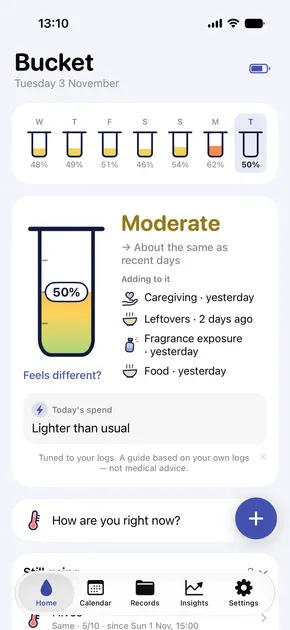
1 of 7. Shauna’s bucket today: how full it is, and what’s in it.
-
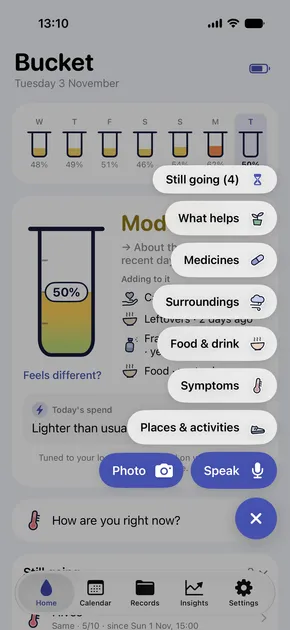
2 of 7. Tap the + and choose what happened.
-
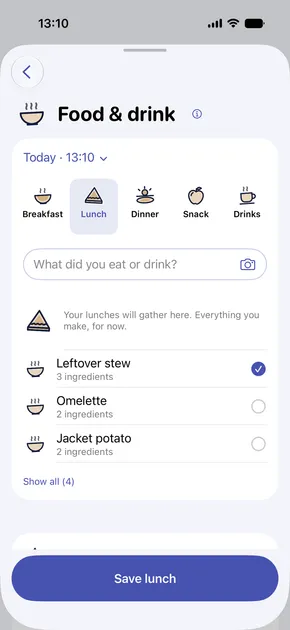
3 of 7. Her usual meals are already there. Tap one, then save.
-
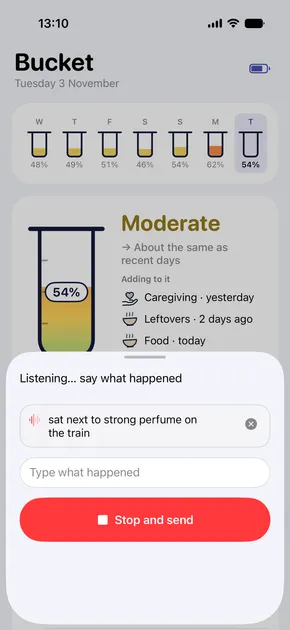
4 of 7. Or just say it.
-
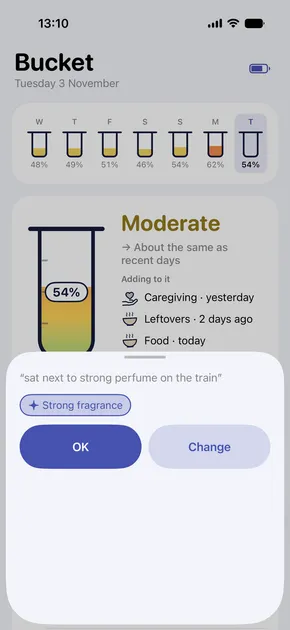
5 of 7. The words become an entry for her to check.
-
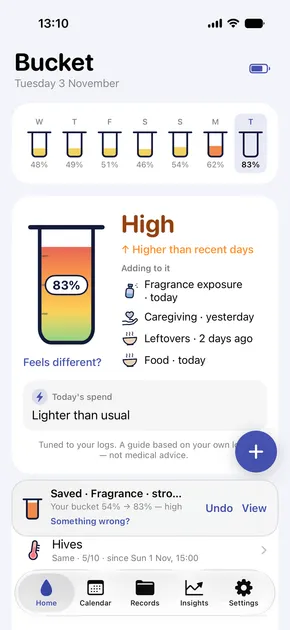
6 of 7. Her bucket rises, and shows what’s adding to it.
-
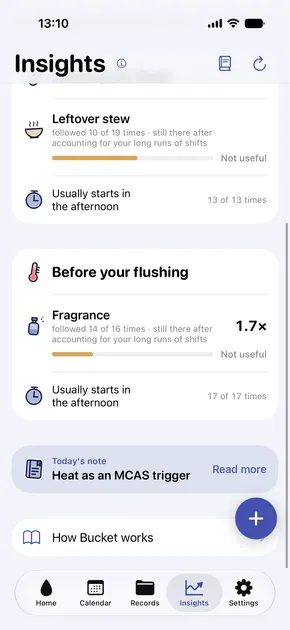
7 of 7. Over time, Bucket shows what tends to come before her symptoms.
Shauna is made up. Her diary is a sample, not a real person’s.
What fills a bucket depends on you.
-
MCAS
Often logged: Fragrance and chemicals, high-histamine foods and leftovers, heat, stress Watching for: Flushing, hives, itching
-
POTS
Often logged: Heat, long workdays, exercise, short nights Watching for: Dizziness, palpitations, brain fog, tiredness
-
EDS/HSD
Often logged: Shifts and lifting, exercise, pressure or rubbing, weather changes Watching for: Joint pain, partial dislocations, tiredness
-
Migraine
Often logged: Fragrance, alcohol, caffeine, weather and pressure changes, sleep Watching for: Migraine, headache
Bucket also supports ME/CFS and long COVID, which often travel with them. All six condition pages
Examples of what people with each condition often log — not a list of causes. You choose what to track, and Bucket learns your own pattern.
Shauna, a made-up sample person
Three days. One bad Wednesday.
It’s rarely one thing. A fragrance, some leftovers and long days caring for her mum — each alone might be fine. Together they filled her bucket.
-
Monday
A strong fragrance. Some flushing at lunch, then it settled.
41% Moderate
-
Tuesday
Leftover stew for lunch. Monday hasn’t drained yet. Hives by the afternoon.
63% High
-
Wednesday
Nothing new — another long day caring for her mum. It tipped over.
85% Near overflow
Bucket looks days back, so you don’t have to.
Once there’s enough in a diary, it shows what tends to come before the symptoms — including the things a day or two back that nobody would spot from a list. It only shows a pattern it can stand behind.
Over time, Bucket shows her
Leftovers tend to be followed by hives within a few hours.
9 of 12 times · 7 separate episodes · held in both halves of her data
Everything you meet puts a little in.
Food and drink, fragrance and chemicals, exertion, stress, pollen and poor air — each adds to your bucket, more if it was strong or long. On a quiet day it drains faster than it fills.
When too much lands close together it overflows — and that’s when symptoms tend to show up, sometimes a day or two after whatever tipped it.
100% is personal: it starts as an estimate and moves to where your own symptoms usually begin. More on how it works
Walk in with a record, not a memory.
Bucket keeps your appointments with the questions you want to ask, and writes a plain summary of what you’ve logged for the clinician you’re seeing. Everything in it is counted on your phone, from your own diary.
It’s for the appointment where you have ten minutes and a foggy head, and the answer to “how often does this happen?” matters.
My summary for rheumatology · Rhys, sample
Why I’m here
Joint pain and partial dislocations.
What has been happening
I logged joint pain on most shift days and a few partial dislocations, more after heavy shifts.
Questions I’d like to ask
What else could I track before next time?
Patterns in my own records — they show what tends to follow what, not what causes it.
Built for the way these conditions really go.
-
Log in a tap or a sentence
Say it, type it or tap it — on your iPhone, your Apple Watch, a widget or with Siri. Voice works with no signal.
-
Smart logging, if you want it
“Two glasses of wine at dinner, headache after” becomes a drink and a symptom for you to check. Off until you turn it on.
-
Scan what you ate or used
Barcodes and ingredient labels are read for you, so a product’s contents go in without typing.
-
Medicines and reminders
Doses taken, missed or skipped — gentle reminders you can answer on your wrist. A missed dose you didn’t log is never counted against you.
-
Apple Health and your Watch
Sleep, steps, heart-rate variability and resting heart rate give the patterns a steady baseline. They stay on your device.
-
Weather, pollen and air
Pressure, heat, pollen and air quality for your rough area are added each day, so you don’t have to.
-
Shifts from your calendar
Work shifts and appointments come straight from your iPhone calendar. Event titles are never stored.
-
Made for foggy days
Soft colours, an easier-to-read font, reduced motion and bigger text. Gaps in your diary are fine — nothing nags.
Find yourself in one of them.
Three made-up people are built into the app, so you can try it before you’ve logged anything. They’re samples — not testimonials.
-
Priya
has POTS and works full time. Her bucket shows what a workday and a hot spell cost her.
-
Shauna
has MCAS and cares for her mum. She logs in gaps — and that’s fine.
-
Rhys
was newly diagnosed with EDS. His records are ready for rheumatology.
Your diary stays on your iPhone and your own iCloud. We have no copy.
Bucket is built so that we can’t see your health data, rather than promising not to look. There’s no account full of your symptoms on a server somewhere — because there’s no such server.
We earn from subscriptions, never from data. No adverts, no trackers, no selling or sharing. If you join the waitlist, your email address is the one thing we hold.
“It took me over a year to connect them.”
After I had Covid, my allergy symptoms got worse. Fragrance started setting off migraines — but often a day or two after I’d been near it, so I never put the two together. It took me more than a year to learn that delayed reactions like that can happen with MCAS.
I have a connective tissue disorder and hypermobility, and I’m still working towards an MCAS diagnosis through the NHS. My GP now prescribes me mast-cell medicines — though he hadn’t heard of MCAS when I first asked.
I built Bucket to find the patterns and delayed reactions I couldn’t see on my own, and to walk into appointments with a record instead of a memory. If that sounds familiar, I built it for you too.
— Chris, who makes Bucket
Questions people ask
How can I track reactions that come a day or two later?
Log what happens and let Bucket look back for you: it checks for things that come before a symptom anywhere from the same day to about three and a half days earlier — the delayed reactions that are easy to miss in a list. It only shows a pattern once it has turned up many separate times, still holds after allowing for your sleep and tiring days, and holds in both halves of your diary. It describes what tends to follow what; it never says what caused it.
Is there an app to track MCAS triggers and symptoms?
Yes — Bucket is an iPhone diary made for MCAS (mast cell activation syndrome). You log what you were exposed to — fragrance and chemicals, high-histamine foods and leftovers, heat, stress — and how you feel, such as flushing, hives or itching. It shows how it all adds up day to day, and looks for what tends to come before your symptoms in your own records.
Is there a symptom tracker for POTS?
Yes — Bucket is an iPhone symptom tracker made for POTS, among other conditions. You log heat, long workdays, exercise and how you feel — dizziness, palpitations, brain fog, tiredness — and it adds sleep, steps, heart-rate variability and resting heart rate from Apple Health, plus the day’s weather. It shows how a day’s load adds up and what tends to come before your symptoms.
Is there an app for tracking EDS or hypermobility symptoms?
Yes — Bucket is an iPhone app made for EDS and hypermobility spectrum disorders (HSD), among other conditions. You log joint pain and partial dislocations alongside work shifts, lifting, exercise and weather, and it shows what tends to come before them. For appointments, it writes a plain summary of what you’ve logged to take to rheumatology or physiotherapy.
Is there a migraine diary that tracks fragrance, weather and sleep?
Yes — Bucket is an iPhone migraine diary that tracks fragrance, alcohol, caffeine and food alongside sleep from Apple Health and the day’s weather and pressure changes, which it adds for you. It looks for what tends to come before a migraine, including things a day or two earlier, and shows how several small things add up.
Can I track high-histamine foods and reactions?
Yes — the Bucket app counts high-histamine foods such as aged cheese, cured meat and leftovers, and notes how old leftovers are. Scan a barcode or an ingredient label and a product’s contents go in without typing, then log reactions like flushing, hives or itching. It shows what tends to follow what in your own records; it never says what caused it.
Where does Bucket keep my diary — can you see it?
On your iPhone and in your own iCloud — and no, Bucket’s maker has no copy and no way to read it. The diary sits in a private space only your devices can open. A few features (smart logging, barcode and weather lookups) send a single item to be read and answered, and nothing from them is linked to you. If you choose to email us a problem report from the app, we see what you send. The privacy policy lists each one.
Is Bucket medical advice?
No. Bucket is a diary, not a medical device: it never diagnoses, treats or tells you what to do. It shows what tends to come before your symptoms in your own records: things to look into, and to take to the clinicians who know you.
Be first to know when it’s ready.
One email on launch day with the App Store link. That’s all.
Planned launch price: 30 days free, then $14.99 a month or $99.99 a year, plus tax. Cancel any time in iPhone Settings.